
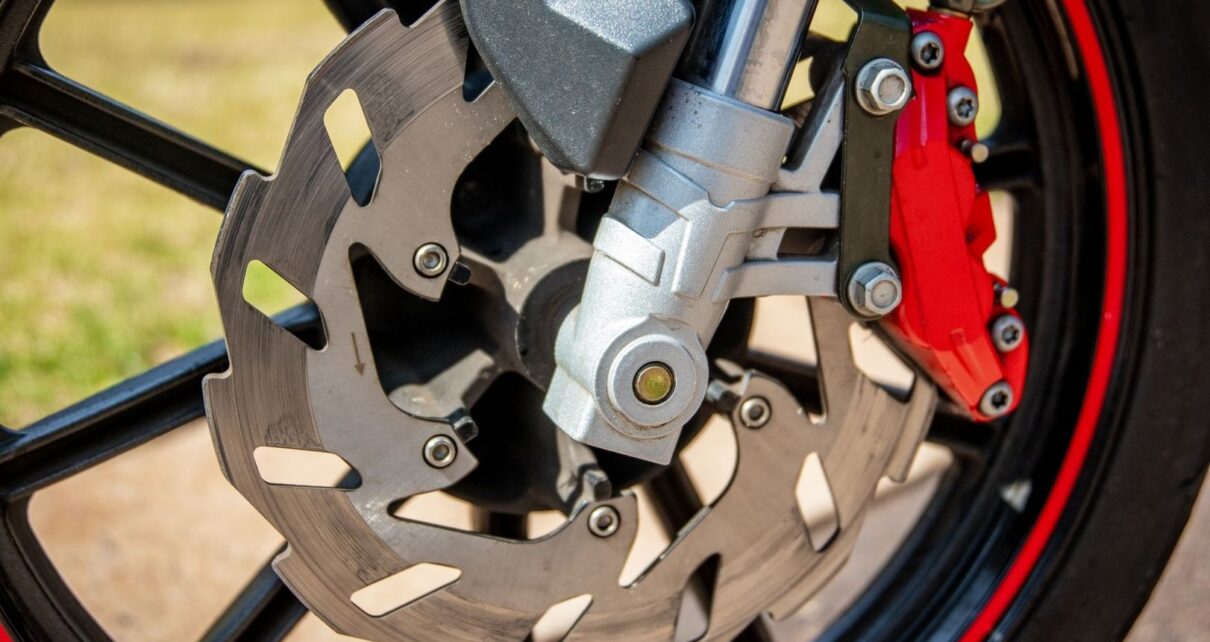
Decoding Friction Beyond the Spec Sheet
The most aggressive brake pad is not automatically the fastest or safest choice. Peak friction is only one part of the braking equation. A pad that delivers a sharp initial bite can feel impressive in the paddock, yet become difficult to control during a cold morning commute, a wet road section, or the first emergency stop at an intersection. Effective braking depends on predictable friction, stable lever feedback, rotor compatibility, and enough thermal capacity for the duty cycle your motorcycle actually sees.
Sintered metallic pads and carbon ceramic compounds approach that problem from different directions. Sintered pads use metallic particles, commonly including copper and other wear-resistant materials, compressed and bonded under heat and pressure. They generally provide strong cold response and broad resistance to fade. Carbon ceramic pads use a ceramic-rich friction matrix designed to remain stable at elevated temperatures, often with a smoother progression as the pad and rotor come up to operating temperature. As shown by recent tribological materials analysis, temperature can radically change friction stability under dynamic loading. The workshop objective is therefore simple: match pad metallurgy to real operating temperatures, braking frequency, weather, and rider input rather than choosing by label alone.
Friction Coefficients and Thermal Operating Windows
The coefficient of friction, commonly represented by the Greek letter mu, describes how much braking force a pad can generate for a given clamping load. It is useful, but it is not a universal score. The same compound can produce a different mu value when the rotor is cold, when the pad is operating in its designed temperature range, or when repeated stops push the system toward fade. Rotor finish, pad transfer layer, caliper stiffness, brake pressure, and speed all influence the result.
Sintered metallic compounds usually establish useful friction quickly after the first application. Their friction curve is often comparatively broad and flat, meaning the pad can produce dependable bite from ambient temperatures through substantial heat loading. That makes sintered material attractive for street motorcycles, heavy machines, wet-weather riding, and track sessions where braking zones are frequent but temperatures vary. The tradeoff is a harsher pad-to-rotor interaction, more noise in some applications, and potentially faster rotor wear.
Carbon ceramic compounds are generally selected for their high-temperature consistency and controlled response rather than maximum cold aggression. A quality compound may feel modest during the first stop, then become substantially more effective as the rotor reaches its intended window. This is valuable on a circuit because repeated high-energy deceleration keeps the system near its design temperature. It can be less satisfying on public roads, where traffic, speed limits, and cooling airflow prevent the brakes from staying hot.
| Characteristic | Sintered metallic | Carbon ceramic |
|---|---|---|
| Cold bite | High and immediately available | Moderate, often more progressive |
| Typical operating behavior | Broad window with strong low-temperature response | Best performance after reaching an elevated temperature threshold |
| Resistance to repeated heat | Very strong for street and mixed track use | Strong when operated within the intended race or performance window |
| Rotor interaction | More abrasive and potentially harder on stainless rotors | Often smoother after a stable transfer layer is established |
| Best duty cycle | Commuting, touring, wet weather, mixed use, heavy motorcycles | Hot canyon riding, repeated track braking, dedicated performance setups |
Do not treat those categories as fixed laws. Pad manufacturers formulate compounds differently, and two pads carrying the same broad material description can behave very differently. Always use the manufacturer”s temperature guidance, friction classification, rotor compatibility notes, and bedding procedure as the final reference.
Initial Bite Sensitivity and Lever Modulation on the Street
Initial bite is the force available as the pad first contacts the rotor. Sintered material tends to key into the microscopic texture of the disc quickly, producing strong deceleration with relatively little lever movement. That response is valuable during an emergency stop, especially when the road is damp or the motorcycle is carrying luggage. The rider receives a clear indication that the brake system is working, and the compound is less dependent on the rotor being fully hot.
Carbon ceramic compounds often deliver a more progressive first response. That can help keep the chassis calm as weight transfers forward. Instead of an abrupt torque spike, the brake builds force in a way that gives the fork, tire, and rider time to settle. For a skilled rider trail-braking toward an apex, this gradual relationship can make small pressure changes easier to manage. It is not necessarily weaker braking; it is a different force curve.
The master cylinder, caliper seals, pad backing plates, and rider”s fingers form a feedback loop. A stiff lever with a predictable rise in pressure lets the rider separate braking phases: initial load, maximum deceleration, and release into corner entry. A pad that is excessively aggressive for the tire and chassis can overwhelm that process. On the street, a panic squeeze over a painted line, steel cover, or wet patch may create an abrupt front-end reaction before the suspension has settled.
- Choose strong cold bite when the motorcycle sees frequent short stops, low ambient temperatures, rain, traffic, or heavy loads.
- Choose progressive response when the chassis is highly sensitive to pitch and the rider prioritizes fine trail-braking control.
- Verify that the pad compound suits the motorcycle”s ABS calibration, because abrupt torque changes can alter how quickly the system intervenes.
- Do not judge a pad by one hard stop. Evaluate lever control, repeatability, noise, rotor wear, and behavior after several normal street stops.
Caliper Thermal Transfer and Fluid Boiling Thresholds
Brake heat does not remain at the pad and rotor. During repeated deceleration, heat travels through the pad backing plate into the caliper pistons, seals, caliper body, and eventually the hydraulic fluid. Copper-rich sintered materials can conduct substantial heat toward the backing plate and piston, depending on the pad construction and the caliper”s thermal design. Ceramic-rich friction materials can act as a partial thermal barrier, reducing the rate at which some heat reaches the hydraulic side of the caliper. The result depends on backing plate thickness, piston material, pad shims, airflow, and the duration of each braking event.
Once brake fluid becomes hot enough to form vapor, the lever can travel farther because gas compresses much more readily than liquid. The rider may experience a soft lever, inconsistent pressure, or a lever that approaches the handlebar after several hard applications. This is different from friction fade, where the pad and rotor lose braking effectiveness despite firm hydraulic pressure. Both conditions can occur together, but the remedies are different.
Heat-management research available through the PMC mechanical heat dispersion literature reinforces the importance of thermal barriers and dissipation paths in enclosed assemblies. In a motorcycle brake system, practical protection includes suitable piston insulators, correctly installed pad shims, clean caliper air passages, and fluid selected for the intended temperature range. High-temperature fluid is not a substitute for maintenance. Brake fluid absorbs moisture over time, which lowers its boiling margin, so a track motorcycle needs regular fluid replacement based on use rather than on a convenient calendar alone.
- Inspect the lever after repeated stops. A change in travel or firmness is an early warning, not a condition to ignore.
- Use the correct piston and pad-shield design. Heat-resistant piston options, including stainless or specialized insulated constructions, can reduce transfer toward the fluid.
- Bleed the system with fresh fluid before demanding track use, and confirm that the fluid specification matches the master cylinder and caliper manufacturer”s requirements.
- Check caliper seals, piston movement, pad clearance, and hose condition before blaming the compound for heat-related problems.
Rotor Wear Dynamics and Bedding Protocols
Sintered pads can wear stainless steel rotors more quickly because their metallic particles maintain a hard, abrasive interface under high load. That durability is useful when the brakes are exposed to water, dirt, heavy motorcycle mass, or repeated thermal cycling. However, a rider who installs a very aggressive sintered compound on a thin street rotor may trade pad life for disc wear. Measure rotor thickness against the service limit, inspect for deep grooves, and monitor the braking surface instead of assuming that a premium pad is automatically rotor-friendly.
Carbon ceramic compounds commonly rely more heavily on an adherent transfer layer. At the correct operating temperature, controlled material is deposited onto the rotor and the pad then works against that layer. A stable layer can produce smooth torque and limit direct abrasion, but poor bedding can create patches of uneven deposition. Those patches may feel like rotor warping because the lever pulses as the pad encounters areas with different friction and thickness.
- Install the pads on a clean, compatible rotor. Replace or properly refinish a disc contaminated by oil, chain lubricant, or an incompatible old transfer layer.
- Confirm free piston movement, correct pad orientation, secure pad pins, and proper lever pressure before riding. The wheel must rotate without abnormal drag.
- Use a series of moderate stops from a controlled speed, allowing partial cooling between applications. Avoid holding the lever while stationary immediately after a hard stop.
- Progress to several firmer decelerations without locking the wheel or activating ABS unnecessarily. The goal is to raise temperature gradually, not shock the pad and rotor.
- Finish with a cooling period under light airflow. Do not park with the brake clamped hard against a hot rotor.
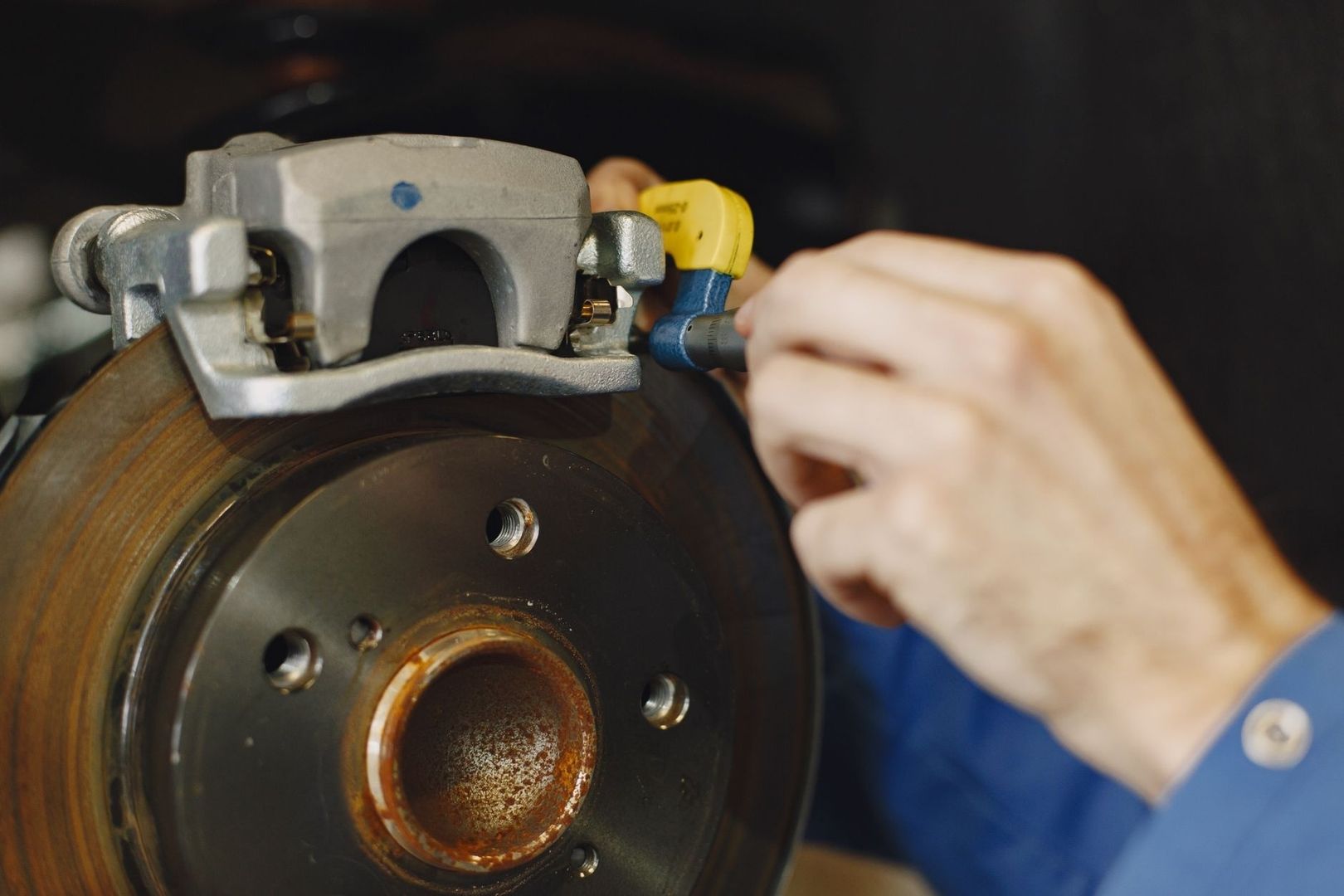
After bedding, inspect both sides of the rotor. Blue discoloration, dark patches, radial scoring, or a pulsing lever can indicate excessive heat, contamination, uneven transfer, or rotor thickness variation. A dial indicator can help distinguish lateral runout from friction-material deposition, while a micrometer can identify thickness variation across the disc. If the rotor is below its service limit, cracked, heavily grooved, or visibly heat-damaged, replace it rather than attempting to rescue the setup with another pad compound.
Dial In Your Setup for Maximum Braking Precision
Pad selection should follow the motorcycle”s actual duty cycle. A daily commuter or all-weather touring bike generally benefits from dependable cold friction, wet-weather consistency, and a wide thermal window. Sintered metallic pads are usually the safer baseline for that use, provided the rotor is compatible and the rider accepts more potential noise and wear. For a mixed street and occasional track motorcycle, a high-quality street-performance sintered compound can be more effective than a full race pad that never reaches its intended temperature.
- Use sintered pads for commuting, touring, rain, cold starts, luggage, and variable traffic conditions.
- Consider carbon ceramic compounds when repeated hot braking keeps the system inside the compound”s specified operating window.
- Choose a dedicated track compound only when tire, suspension, rotor, caliper, and fluid capacity support its added thermal demand.
- Record lever travel, pad thickness, rotor condition, and fluid service dates after each demanding event.
- Stop immediately if the lever becomes soft, braking torque changes sharply, or the rotor shows cracking or severe heat spotting.
Aggressive canyon riding and track duty can justify carbon ceramic friction when the brake system remains hot enough to use it properly and the rider wants progressive control deep into a braking zone. That choice still requires disciplined bedding, fresh fluid, adequate cooling, and regular inspection. The best setup is not the one with the highest advertised friction number. It is the one that delivers the same lever response from the first corner to the last, preserves rotor health, and gives the rider enough modulation to brake later without sacrificing control.